

Gửi bình luận
DNO - In recent years, as Da Nang deepens its international integration, the city has made significant progress in environmental cooperation, supporting its goal of becoming an environmental city and advancing green, sustainable development.
Strengthening cooperation in environmental protection
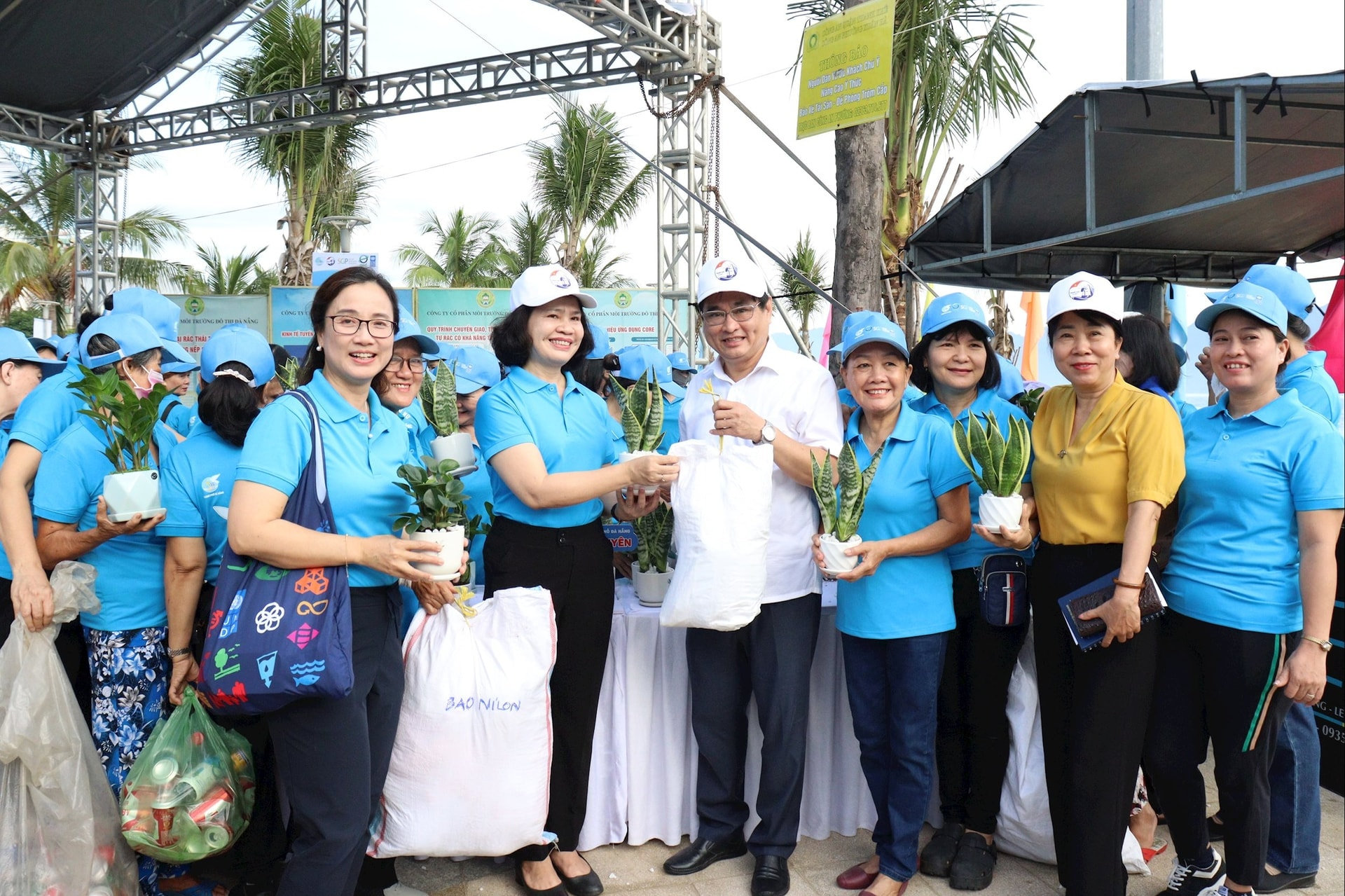
Pham Nam Son, Director of the Department of Agriculture and Environment, noted that from 2021 to 2025, Da Nang partnered with over 10 international organisations to implement 13 environmental projects worth over VND 70 billion, focusing on solid-waste management, waste sorting at source, plastic-waste reduction, and climate-change adaptation.
Among the highlights is the 3R (Reduce-Reuse-Recycle) project, funded by JICA (Japan International Cooperation Agency) under the Da Nang - Yokohama partnership, to establish a Japanese-standard recycling system and strengthened public awareness of proper waste sorting.
Two major programmes, funded by the United States Agency for International Development, focusing on water-resource protection and reducing plastic pollution, are producing practical results in coastal areas.
In addition, the United Nations Development Programme is supporting pilot models of integrated waste management in Ngu Hanh Son District and western Da Nang, creating effective community-level systems for sorting and recycling.
Since April 2025, former Da Nang and Quang Nam have also been implementing a biodiversity-conservation project funded by WWF (World Wide Fund for Nature) to promote local participation in achieving the GBF (Global Biodiversity Framework) objectives through 2027.
According to the department, international cooperation not only provides financial resources but also gives the city access to advanced technologies, modern management methods, and scalable pilot models, helping raise public awareness and improve urban environmental quality.
Expanding partnerships for sustainable development
Da Nang Looking ahead, Da Nang identifies international cooperation as a key solution to achieving sustainable development and reaching carbon neutrality by 2050.
Priority areas include greenhouse-gas inventories, MRV (Measurement- Reporting- Verification) systems, implementation of NDC (Nationally Determined Contributions) commitments, low-emission urban development, green infrastructure, and ecosystem-based adaptation.
The city plans to deepen partnerships with Japan, Singapore, South Korea, Thailand, European countries, and international organisations across ASEAN to learn from global experience and access technologies for renewable energy, resource circularity, and eco-urban development.
The city is also taking part in major initiatives such as the World Bank’s World Cities Programme, the ASEAN Smart Cities Network, and KOICA (Korea International Cooperation Agency)-supported projects on environmental management and disaster resilience.
Da Nang is developing the proposal “Da Nang - A low-emission city”, focusing on cutting fossil-fuel use, expanding renewables, promoting green transport, and building net-zero eco-urban areas.