Gửi bình luận
DNO - Vietnam’s import-export turnover reached a record high in the first 10 months of 2026, officially surpassing the US$1 trillion milestone for the first time.
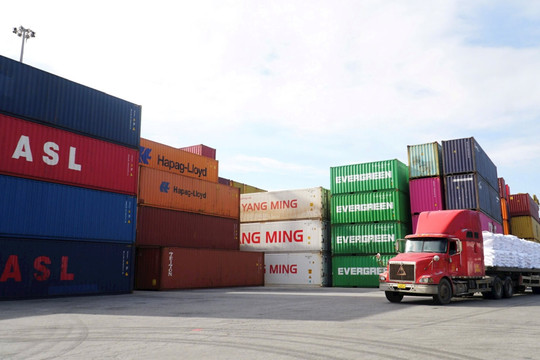
Vietnam’s import-export sector has reached a major milestone, with total trade turnover estimated at US$1,010.55 billion in the first 10 months of 2026, exceeding the US$1 trillion threshold for the first time.
The achievement was underpinned by strong export growth, with export turnover estimated at US$499.24 billion, up 27.5% year on year.
The milestone is an important driver of economic growth and lays the groundwork for Vietnam to achieve its annual export growth targets.
Notably, in less than two decades since officially joining the World Trade Organization (WTO), Vietnam has seen its import-export turnover expand dramatically, rising from US$100 billion in 2007 to the US$1 trillion mark this year.
According to the Customs Department under the Ministry of Finance, Vietnam currently ranks 18th globally in exports and 20th in imports. It also has the second-largest total trade turnover in ASEAN after Singapore.
Mr. Nguyen Anh Son, Director of the Import-Export Department under the Ministry of Industry and Trade, attributed the achievement to the combined impact of a robust recovery in domestic production, particularly in manufacturing and processing, and the leading role played by foreign-invested enterprises (FDI) in key sectors such as electronics, machinery, textiles and garments, and footwear.
At the same time, the effective use of Free Trade Agreements (FTAs) has enabled Vietnamese goods to gain greater access to promising emerging markets in the Middle East, South Asia, Africa and Latin America.
In particular, businesses' proactive and flexible approach to meeting technical standards, embracing green transformation and adapting to changes in global trade policies has provided sustainable momentum for export growth.
With 18 FTAs in force and another under negotiation, alongside next-generation agreements such as the Comprehensive and Progressive Agreement for Trans-Pacific Partnership (CPTPP), the EU - Vietnam Free Trade Agreement (EVFTA), the UK - Vietnam Free Trade Agreement (UKVFTA) and the Regional Comprehensive Economic Partnership (RCEP), Vietnam is expanding its market reach and reinforcing its position as a key link in global supply chains.
To date, Vietnam has established trade relations with 237 countries and territories, including 36 export markets and 31 import markets, each with trade turnover exceeding US$1 billion.
According to experts, Vietnam is making effective use of the advantages offered by its 18 signed FTAs as part of its broader international integration efforts, giving domestic products greater opportunities to reach global markets.
Notably, after recording trade deficits throughout the first eight months of the year, Vietnam saw its trade deficit narrow from US$20.46 billion to US$12.07 billion in September and October alone, according to the National Statistics Office.
This improvement reflects positive growth momentum and underscores the pivotal role of merchandise trade in driving economic growth.
Under the Ministry of Industry and Trade’s orientation, the draft Strategy for the Import and Export of Goods to 2030, with a vision to 2045, sets a target of achieving average annual export growth of 15-16% during the 2026 - 2030 period. Vietnam also aims to maintain a sustainable trade surplus and become one of the world's 10 largest exporters by 2045.
To achieve these objectives, the draft strategy calls for greater diversification of import and export markets, reducing market concentration and pursuing balanced development in both breadth and depth.
Specifically, by 2030, no single export market is expected to account for more than 25% of Vietnam's total export turnover, helping spread market risks and limit vulnerability to trade shocks.
At the same time, Vietnam aims to expand its export market coverage, increasing the number of markets with export turnover exceeding US$1 billion to more than 45 by 2030 and over 55 by 2045.
