


Gửi bình luận
DNO - Vietnam has moved up one place to 43rd among 139 economies in the 2026 Global Innovation Index (GII), according to a report released by the World Intellectual Property Organization (WIPO) in Geneva on September 29.
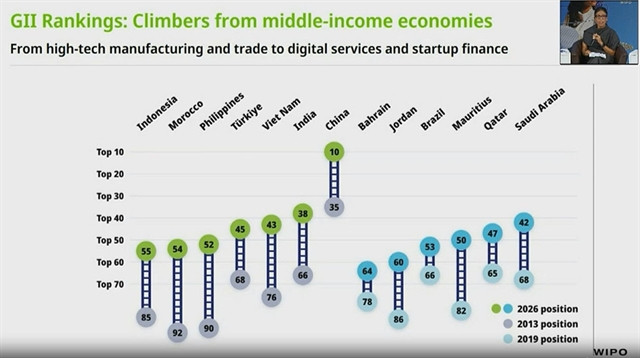
The ranking marks a significant improvement in Vietnam’s standing over the past decade, from 59th place in 2016 to 44th in 2024 and 2025 and 43rd in 2026.
Vietnam ranked third in Southeast Asia, behind Singapore and Malaysia. WIPO also identifies Vietnam as one of seven middle-income economies that have made the strongest long-term advances since 2013, alongside China, India, Turkey, the Philippines, Morocco and Indonesia.
Vietnam is also one of three economies whose innovation performance significantly exceeded what would be expected based on their level of development, alongside China and India. For 16 consecutive years, the country has recorded innovation performance above the level expected for its level of development, indicating its effectiveness in turning innovation inputs into outputs.
A notable improvement came from innovation outputs, with Vietnam rising two places to 35th. Several output indicators improved in 2026. Patent applications by country of origin rose three places to 63rd while high-tech manufacturing advanced one place to 25th.
The complexity of production and exports climbed eight places to 44th, and industrial design applications by country of origin increased three places to 48th.
Vietnam also maintained several notable global strengths. According to WIPO, it ranked first worldwide in both the share of high-tech exports and the share of creative goods exports in total trade. Also, it ranked third in the share of high-tech imports, fifth in the number of smartphone applications developed and used, and sixth in labor productivity growth.
Among Viet Nam’s notable GII results in 2026, high-tech exports and high-tech manufacturing continued to account for significant shares of the country’s trade and industrial output while creative goods remained an area of strong global performance, according to the Vietnamese Ministry of Science and Technology.
The country’s startup ecosystem also continued to develop, with three billion-dollar unicorns and a growing number of startups operating in science- and technology-intensive fields.
These above-mentioned good results reflect Viet Nam’s growing integration into global manufacturing and technology-related value chains.
WIPO noted that the country has developed strengths in high-tech trade and manufacturing while also highlighting the need to expand domestic research, patenting and knowledge creation to move into higher-value activities.
Who leads global innovation in 2026?
Switzerland – ranked 1st for a 16th consecutive year – Sweden and the United States remain the world’s top three innovation economies.
The leading economies are broadly those of 2025. No new economy enters the top 15, and Europe again accounts for the largest share of the leading group – with 14 economies out of 25 innovation leaders.
Asia is also firmly embedded among the top ranks, with five economies in the top 25: the Republic of Korea, Singapore, China, Japan and Hong Kong (China).
Under its science, technology and innovation development strategy through 2030, Vietnam aims to place among the world’s top 40 economies in the GII. A longer-term target under Resolution No. 57-NQ/TW is to enter the world’s top 30 by 2045.
To support these goals, the Vietnamese Ministry of Science and Technology has identified priorities, including improving the policy framework, increasing investment in research and development, as well as attracting major international companies to establish R&D centres and expand investment in high-tech and strategic technologies in Vietnam.
The country also aims to strengthen the quality of its human resources and research capacity, deepen cooperation among research institutes, universities and businesses, attract funding for technology-based startups, develop innovation clusters and networks, and help enterprises adopt, absorb and master technologies to improve productivity and competitiveness.
The GII 2026 results indicate positive progress in Viet Nam’s innovation outputs.
However, reaching the global top 40 and, ultimately, the top 30 will require continued improvements in human resources, research capacity, investment efficiency and the participation of businesses in the national innovation ecosystem.
The next stage of development will require stronger domestic research, knowledge creation and higher-value participation in global value chains.
The Global Innovation Index 2026 ranked the innovation performance of 139 economies, maps the world’s top 100 innovation clusters, and tracks the main global innovation trends.
This year’s special GII theme asked how deep science startups turn frontier research into new industries, and what it takes for them to scale.
The GII assessed economies worldwide based on their innovation capabilities. Comprising roughly 80 indicators grouped into innovation inputs and outputs, the index aims to capture the multidimensional nature of innovation.