


Gửi bình luận
DNO - Resolution No. 26-NQ/TW dated August 22, 2026, issued by the Politburo, identifies tourism as a key economic sector in the new era. Under this strategic direction, Da Nang is designated as one of Vietnam’s three tourism growth poles by 2030.
According to the Da Nang People’s Committee, as of late August 2026, Da Nang had served over 14.2 million overnight visitors, including nearly 6.9 million international visitors.
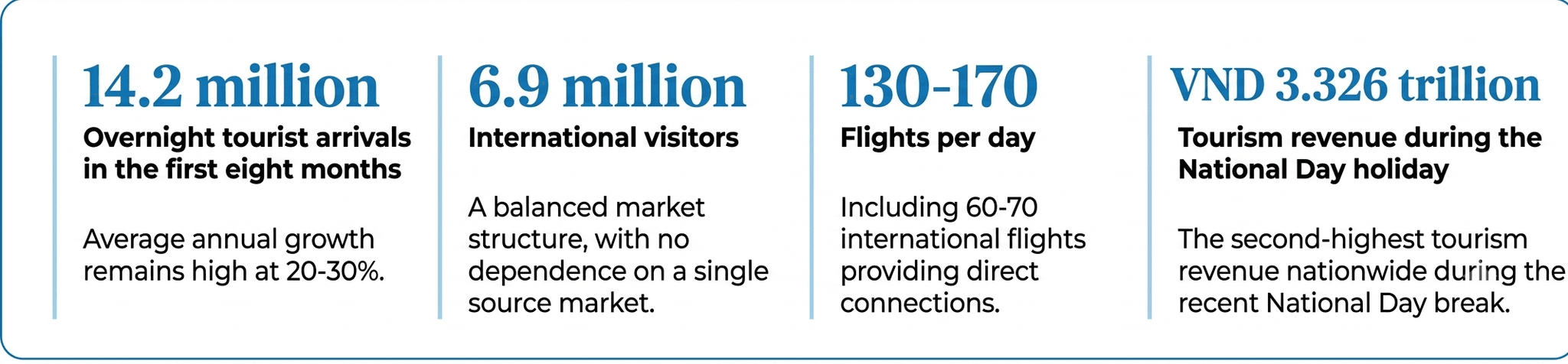
The city has emerged as an attractive domestic and international destination, with annual visitor growth remaining high at 20-30%.
On average, the city handles around 130-170 inbound and outbound flights per day, including 60-70 international flights.
Notably, actual passenger throughput at the domestic and international terminals of Da Nang International Airport has exceeded their designed operating capacity.
To realize the goal, Da Nang plans to rapidly upgrade strategic inter-regional infrastructure and introduce new “open spaces” in a bid to create fresh momentum for the city's tourism sector.
.jpeg)
In late August 2026, the local authorities announced a project to renovate and expand passenger terminal T1 at Da Nang International Airport with an investment of nearly VND10 trillion.
Scheduled for completion in 2029, the project aims to increase the airport’s total annual capacity to 14 million passengers.
At the same time, the city has identified trade and services as among the priority sectors for investment in areas within the Da Nang Free Trade Zone.
It has planned to establish bustling shopping, financial and service centers with tax exemptions and preferential policies, as well as develop world-class tourism and entertainment spaces in the future, including beach parks, casinos and marinas.
Additionally, the city is studying the conversion of the Tien Sa Port into a dedicated cruise and tourism port, aimed at boosting Vietnam's marine tourism.
Da Nang boasts unique advantages to become an important growth pole for Vietnam’s tourism, with such World Heritage sites as Hoi An Ancient Town and My Son Sanctuary, the Cu Lao Cham - Hoi An World Biosphere Reserve, as well as its extensive network of sea and islands, rivers and mountains, and high-end tourism resorts
Assoc. Prof. Dr. Pham Trung Luong, Vice Chairman of the Vietnam Tourism Training Association
According to the draft adjustment to Da Nang's master plan to 2050, with a vision to 2075, the city’s tourism space will continue to expand from traditional areas such as Hoi An, My Son, the Han River and coastal areas to Lang Van - Nam O - Xuan Thieu - Thanh Khe, Son Tra, Man Thai - My An, Cu Lao Cham, Tam Thanh - Tam Hai, as well as mountainous areas in the west and south.
The plan is expected to add more than 20 tourism zones and attractions to make more effective use of the city’s natural and cultural resources.
.jpg)
One of the city’s key development priorities in the coming period is to enhance competitiveness through digital transformation and green tourism development.
The city currently has a total of six special national-level relic sites, 84 national-level relic sites, 475 municipal-level relic sites, 30 intangible cultural heritage items and documentary heritage items, as well as more than 200 relic sites listed in the heritage inventory.
It is working to build a comprehensive digital heritage system, including 2D digitization of 415 relic sites, the development of 37 VR360 virtual tours, and 3D digitization of six selected national-level relic sites.
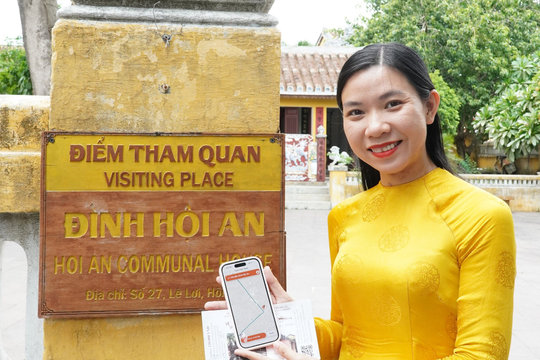
According to the municipal Department of Culture, Sports and Tourism, the local tourism sector has adopted numerous digital platforms and technologies, including VR360 virtual reality, online exhibitions, chatbots, Da Nang tourism applications on mobile devices, and promotional channels on Klook, KKday, Traveloka and Google.
Accommodation businesses have also shifted toward digital platforms such as Agoda and Booking to attract visitors.
.jpg)
Alongside digital transformation, green tourism has been identified as an important requirement for improving destination quality.
Da Nang has pioneered the development of a Green Tourism Criteria which help businesses pursue their green transition.
Da Nang’s tourism development orientation to 2030, with a vision to 2045, continues to focus on shifting from attracting “more visitors” to generating “higher value” by targeting visitors with high spending power and longer stays.
The city eyes simultaneously developing cultural, ecological, agricultural, rural, medical, sports and experiential tourism, as well as applying digital platforms to tourism promotion.
Also, it will lay an emphasis on expanding markets in Northeast Asia, India, Europe, Australia, the Middle East and North America in the years ahead.