

Forest protection in Dong Ram
DNO - Nearly 30 years ago, as forests in the western mountainous area faced widespread destruction, residents of Dong Ram Village (Thanh My Commune, Da Nang city) united to establish community rules and committed themselves to protecting their forests.
.jpg)
From that collective vow, tens of hectares of ancient trees still stand proudly at the heart of today’s Thanh My Town, shielding the homeland of the Co Tu, Kinh, Tay, and Nung communities along the legendary Ho Chi Minh Trail.
Dong Ram remains lush and vibrant- surrounded by old-growth forests and expansive rice fields nestled in an eastern Truong Son valley.
The community’s heritage
Seven members of the Dong Ram Community Forest Protection Team set out on a 5km patrol through the ancient forest, checking the headwater stream and key areas under their management.
Led by village chief Blup Mung, the team works meticulously, reporting any unusual signs and helping to remove threats to the forest.
With over a decade of dedication, Blup Mung now leads 15 members, conducting monthly patrols and managing more than 120 hectares, including buffer zones of the Elephant Conservation Area.
He also raises awareness at community meetings to encourage broader participation in forest protection.
.jpg)
According to Dong Ram Party Cell Secretary Riah Nhong, Dong Ram’s forest protection efforts date back to the 1980s, when villagers pledged to safeguard water source forests, laying the foundation for today’s strong community-based conservation model.
Waiting for the “sweet fruit”
By late November, mist settles over Dong Ram - a plateau framed by mountains, with forests above and rice terraces below. Here, the Co Tu, Tay, and Nung communities live just steps from the protected primaeval forest.
According to Nguyen Van Ruoc, a Tay former village chief, his family has protected more than 2.9 hectares of ancient Nghien trees (Burretiodendron hsienmu) since 2000.
He's also helped mobilise local residents to safeguard the headwater forest and later developed livelihoods such as raising local black pigs and growing medicinal plants and native vegetables under the forest canopy.
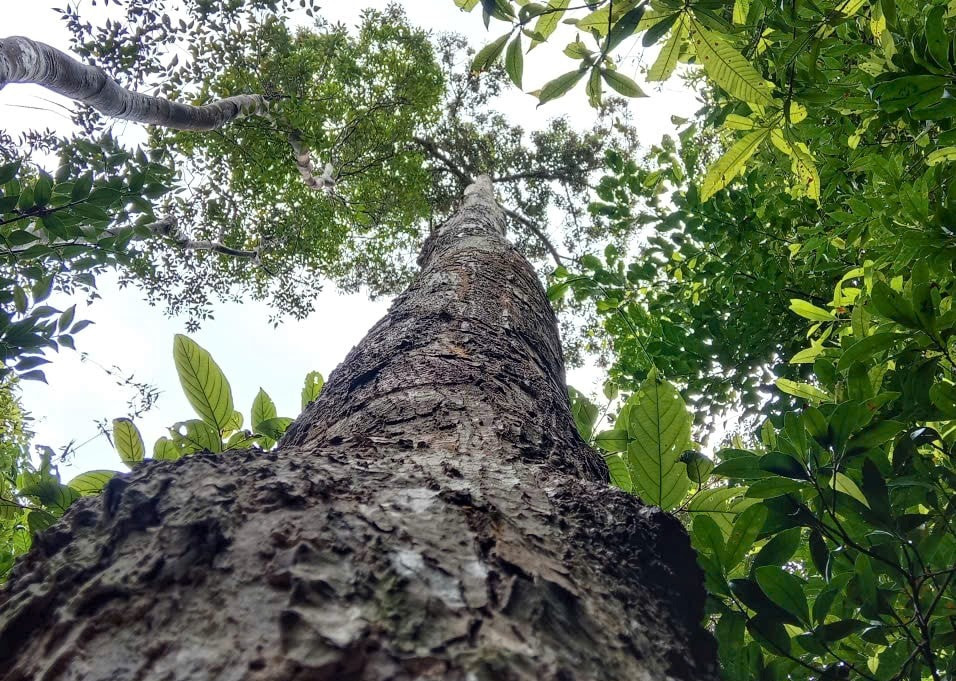
Reportedly, Dong Ram is a model of community-based forest conservation. Forest environmental service payments have supported local development, while plans for ecotourism will help turn the ancient forest into a unique attraction.
Dong Ram Village with 104 households has reduced poverty as residents expand wet-rice cultivation, livestock raising, and community-based tourism development.